This past June, Trenten became the first person in Portland to be picked up from his house and charged with federal crimes for alleged protest activity at the ICE facility in the SW waterfront area.
The federal government alleges that a lit flare that minorly damaged the building’s front gate constitutes “arson”. A federal judge sentenced him to 18 months in prison for that very flare, along with having to pay fines that total to $8,820.
The judge openly admitted in court that Trenten was being used to make an example to others who dared protest at the ICE facility.
This sentence is utterly barbaric, and it comes in the midst of increased aggression against anti-fascists all across the amerikan settler colony who have risen up to fight back against ICE.
All across amerika, the empire’s federal agents continue to violently enforce this settler colony’s fascist agenda. Masked police kill people in the streets. The amerikan government disappears our neighbors into concentration camps. And they do this with no end in sight. With impunity.
People who express dissent and stand up to fight back for their neighbors are targeted, brutalized, and imprisoned. Trenten is no different. And it is on us to now take care of him in his time of need.
Trenten will report to federal prison at the end of April 2026.
You can begin to write to him then at the following address:
TRENTEN BARKER #93764-511
FCI LOMPOC II
FEDERAL CORRECTIONAL INSTITUTION
3901 KLEIN BLVD
LOMPOC, CA 93436
Trenten is being sent all the way to Lompoc because the Feds have designated him to be “too dangerous” to be at a camp in Oregon. This is yet another attempt by the fascist police state to attempt to isolate Trenten and remove him from his support system.
We cannot allow that to happen. Solidarity is a verb, and we are all we have.
Send Trenten love! Let him know that bravery comes with the reward of endless love and solidarity from your community.
Michael Kimble’s Statement And Calls to Action For February 8th Prisoner Work Strike
On February 8th 2026 prisoners in the state of Alabama are doing it again!
The Free Alabama Movement (FAM) made the call for prisoners to shut this shit down (work strike) and prisoners throughout the state is answering this call to action on February 8th by refusing to participate in their own exploitation and oppression. There will be no work (slave labor).
The demands from prisoners at the prison i’m being held captive in (Ventress Correctional Facility) are:
TOTAL ABOLITION OF PRISONS, ELIMINATION OF LWOP SENTENCES (LIFE WITHOUT PAROLE) AND THE DEATH PENALTY
We refuse to continue playing a part in our own slavery, exploitation and oppression by withholding our labor power.
JOIN US BY BEING CREATIVE AND FIGHTING TO ABOLISH PRISONS.
Some suggestions for thse out in minimum kustody (so-called free world):
BANNER DROPS
AGITATION AND EDUCATION
HOLD A SCREENING OF THE DOCUMENTARY “THE ALABAMA SOLUTION”
GRAFFITI
WRITE A PRISONER
DIRECT ACTION
The state of Alabama department of corrections has already begin to attempt to derail the work strike by weaponizing food and limiting the amount of food prisoners can purchase from the commissary, and bird feeding us.
This morning we were all served a small portion of soupy oatmeal, one slice of bread and a spoonful of jelly, and a spoonful of gravy. For lunch we were served one fish patty, one slide of bread, and a spoonful of English peas.
We also suggest that you call and demand that we are given full, nutritious meals.
The political prosecution of anti-zionist activist, Raunaq Alam.
Raunaq Alam is a community organizer and activist from the Dallas-Fort Worth area. The son of two survivors of the Bangladesh genocide in the early 1970’s, Alam has organized non-stop in his community to protest the zionist settler colony of “israel” and its own ongoing genocide of the Palestinian people.
“There was a time when my dad was traveling between the rivers on a boat to go to his uncle’s house, and he saw, like, a pile of skeletons in the river, just stacked on the bank. Bodies just being thrown in the river…So that’s images that are just burned into my family’s heads that, unfortunately, are having to be resurfaced from all of the imagery that we’re seeing from the very brave journalists in Gaza.”
On March 7, 2024, Raunaq, alongside two of his other co-defendants, plastered pro-Palestine stickers and graffiti reading “fuck israel” beneath the flagpole of a zionist church in Euless, Texas. The church had been open on social media about its explicit support for the zionist settler colony and even provided material support to the israeli occupational forces in 2023, in the midst of their ongoing slaughter and ethnic cleaning of Palestinians in Gaza.
The direct action was caught on the church’s surveillance cameras, and prosecutors obtained a warrant on March 22nd, 2024. Raunaq was arrested by local police and the FBI shortly after they arrived at his job that day.
Following his detainment after he refused to speak to law enforcement and asked for his attorney, local police on site began unconstitutionally searching his vehicle without a warrant or legal means.
From the start, nothing was typical or usual about Raunaq’s case. To consider his prosecution as anything other than a racist, political sham job would be utterly disingenuous. As of the date of this publication, Raunaq has just been re-arrested for the eighth time in this case. At a court hearing earlier on January 16, 2026, a judge ruled that Raunaq’s initial bail was not high enough due to fact that he has been posting against ice on social media. The state ruled that even if Raunaq is able to make bond (which was raised to $80,000 at the hearing) he is not to possess any social media accounts and must have government installed spyware put onto all of his devices.
This re-arrest and unjust ruling by the court speaks volumes about the racist nature of Raunaq’s case, and it should raise alarm bells that the state has explicitly gone on the record to assert that he does not have any rights to free speech while he continues to be subject to repression and surveillance by the state, all for his staunch support of the Palestinian people.
In a filing arguing for a new bond after his initial arrest in 2024, his defense attorney, Adwoa Asante, wrote, “His car was locked and legally parked as an employee of The Sam’s Club parking lot where he worked… Officers took custody of his keys, unlocked his car, and searched his car without a warrant. While Detective Norvell had his body camera activated for Mr. Alam’s arrest a mere 5 minutes before the search, his body-worn camera was deactivated for the search.”
During this illegal search, the police allegedly found less than a gram of psilocybin mushrooms in Raunaq’s car. Police on the other hand claim that there was no illegal search that occurred of the vehicle, and that officers simply discovered the drugs when they “inventoried” his car before having it towed from the parking lot. The DA filed charges for possession of a controlled substance shortly after the search.
A grand jury that was impanelled to indict Raunaq initially found insufficient evidence to formally charge him in the matter. This itself should speak volumes about the nature of the state’s sham case against him, given the incredibly high rate of successful indictments that occur at the hands of grand juries. For reference, in Harris County, a more diverse and progressive part of Texas, grand juries returned indictments in over 97% of all cases presented between 2014-2019. In federal court, grand juries indict in over 99% of all cases they see. Tarrant County impanels grand juries to hear around 19,000 cases each year, and Raunaq’s case was just one of few that did not result in a successful indictment for the state.But this did not stop the state of Texas from continuing to politically target Raunaq.
The fact that Raunaq allegedly had mushrooms in his car is just a convenient excuse and doesn’t actually mean anything. Much like the racist depiction the state created during the political prosecution of Tarek Bazrouk, a young Palestinian man serving a preposterous year long sentence in federal prison for “hate criming” zionists, possession of marijuana that was found during a raid of his home was also included in the large scale character assassination campaign that the state waged against him. But mushrooms, weed, and even many other substances are incredibly common among many of Tarek and Raunaq’s peers. However, people like Tarek and Raunaq aren’t like most people their age. They are political prisoners — brown, muslim men that have been incarcerated due to their steadfast resistance against the zionist settler colony and its genocide of the Palestinian people. The state does not consider anything they do to be harmless.
While Raunaq was initially offered probation for allegedly tagging the wall underneath the flag pole of the church, this deal was quickly rescinded just less than a week later, after a career death penalty prosecutor, Lloyd Welchel, was assigned to try Raunaq’s case in the courtroom of a misdemeanor judge in the county.
Welchel elevated the misdemeanor graffiti charges to felony criminal mischief and even slapped down a preposterous hate crime enhancement onto the case, arguing that Raunaq’s actions stemmed from a hatred of Jewish people. As a result of this enhancement, Raunaq went from looking at possible probation and restitution like most people who get caught tagging, to the chance of a maximum sentence of 10 years in state prison.
The state wasn’t prosecuting Raunaq for what he did. The state was prosecuting Raunaq for whyhe did it.
Defense attorney, Adwoa Asante, stated that it is dubious to maintain Raunaq’s action constitutes a hate crime. Raunaq did not target a synagogue, and the message did not single out a group protected under Texas’ hate-crime statute.
“Nowhere in the statute does it cite governmental entities such as states as part of protected persons or groups. If citizens and persons within the United States are allowed to say and express ‘(Expletive) America’, why would the condemnation of a foreign country garner more enhanced prosecution from the state of Texas?”
While one of his co-defendants shamefully took a cooperative plea deal, Raunaq went to trial in early September of 2025, and the racist theatrics that unfolded in the courtroom are hard to stomach.
Raunaq’s defense team initially moved to prevent the jury from seeing a completely unrelated and possibly prejudicial video from one of his previous birthday parties, where he and a group of friends, including both of his codefendants, burned American and Israeli flags in a bonfire. In the background of the video, you can hear someone playing a satirical rendition of the Star Spangled Banner on what happens to sound like a recorder, while the group of people stands around the fire pit with their hands covering their hearts.
Although flag burning has continuously been upheld as protected free speech by the Supreme Court, the prosecution preposterously argued that just because a form of speech was protected by the first amendment, doesn’t mean it didn’t prove motive to later commit a crime. The judge ended up allowing for the video to be played in the courtroom but excluded the audio from being played on the grounds that it could potentially prejudice the jury.
The defense and prosecution then battled out their vastly different definitions of anti-semitism and anti-zionism, placing different experts on the stand to educate the jury on the matter. While the defense witnesses argued that synthesizing criticisms of Israel with criticisms of Jews was a dangerous mistake, the state of Texas attempted to go on the record and create a legal precedent that inherently conflated the two — in order to explicitly criminalize any form of speech that criticizes the zionist settler colony.
Central to the state’s argument was this hypocritical claim that preventing others from being able to think how they wanted constituted terrorism, and that was allegedly what Raunaq did when he tagged the church for choosing to support the zionist settler colony’s ongoing genocide of the Palestinian people.
But as if this was not enough, in his closing statement to the jury, the prosecutor on the case argued that Raunaq was a “thug” and “terrorist”, before motioning to a gallery full of Raunaq’s supporters, many being brown and Muslim as well, and stating, “that’s who they are.”
Seeing through all of this immense racial prejudice and Islamophobia, the jury ultimately rejected the exaggerated hate crime enhancement and convicted Raunaq just of the criminal mischief charge instead, sentencing him to community supervision and a preposterous $10,000 fine.
However, the judge on the case decided that this simply was not good enough.
Judge Bolton ordered Raunaq to write a hand written apology letter to the head pastor at the zionist church that explains why he believes what he did was wrong. Then, in a shock even to members of the jury, the judge additionally imposed a 180 day sentence to be served in Tarrant County Jail. While gasps filled the courtroom, the judge also ordered Raunaq to be subject to mandatory random drug testing and imposed a probation period of five years.
One member of the jury was so astonished by the judge’s verdict, that they looked toward another juror in order to confirm that they had not accidentally imposed the 180 day jail sentence on Raunaq themselves.
Although Raunaq should have walked out of the courtroom that day with his friends and family, he was instead promptly taken into custody by sheriffs deputies. Members of the gallery who came to support him at trial all began to shout out their love for Raunaq — he responded by raising his right fist.
Raunaq was immediately placed into maximum security at the county jail.
Shortly after Raunaq was taken into custody, Dr. Barry Trachtenberg, a defense witness and the chair of Jewish History at Wake Forest University, said, “I thought the prosecutor was very afraid of hearing about the genocide that is happening in Gaza and sought to deny the jury the right to hear that information… I’m grateful that the jury has rejected the baseless claim by the prosecution that a state — especially one that is currently committing a brutal genocide against Palestinians — deserves special legal protections to shield it from any and all criticism.”
“By referring to Raunaq Alam as a ‘terrorist’ because of his advocacy for Palestinian lives in its closing remarks, the state made its racist intentions against the defendant clear for all to see — and the jury recognized that,”said Dr. Barry Trachtenberg.
Raunaq’s defense team appealed the unjust 180 day jail sentenced imposed by the judge against the explicit wishes of the jury that was responsible for determining his fate. A little over a week later, Raunaq was released from Tarrant County jail after posting his bond. However, prosecutors later filed a motion to argue that his bond was insufficient, and cited text messaged submitted during trial that included various mentions of controlled substances, alongside arguing that Raunaq had perjured himself by denying on stand that he had used drugs.
Raunaq’s defense attorney stated, “the Tarrant County DA’s office has demonstrated a genuine fear of anti-genocide activists through the criminalization of all of Raunaq’s speech and his confinement in maximum security. They were so desperate to charge him with something that they didn’t take the appropriate steps to even appear neutral in this perjury charge. The same prosecutor that questioned him during the official proceeding alleging the perjury is the same prosecutor that went to the grand jury to procure an indictment. This is an obvious conflict, as he has now become a witness in his own case. Prosecutorial retaliation is an abuse of power, and while history will vindicate Raunaq Alam for his genuine attempts to bring attention to a genocide against Palestinians, history will remember the Tarrant County DA’s office as heavy-handed, careless, and power drunk…They’re trying to revoke his bond on the drug charge, even though he hasn’t had any violations. So they’re essentially trying to revoke his bond for thought crimes…I think it’s very important for people to understand: Fascism is here.”
After his arrest following the filing of aggravated perjury charges against him, Raunaq was released on home confinement from maximum security custody. Tarrant Country Sheriff Bill Waybourn called him a high profile inmate due to the political nature of his case. Raunaq was then forced to dawn an ankle monitor in his family home for weeks on end.
Raunaq has most recently been arrested againfollowing a court hearing on January 16, 2026 — with the judge arguing that this initial bond is insufficient due to him posting against ice and donald trump on his social media accounts. If he is indeed able to post his bond yet again, the judge has ordered Raunaq to not have any access to his social media accounts and has also ordered the government to install spyware and tracking software onto all of his devices.
This is blatant political retaliation against a brown man already facing an unjust political prosecution, and it horrifically mirrors many of the repressive tactics that the state is using against other activists in the area. One such person is Dario Sanchez, one of the defendants in the Prairieland case that has also been forced to have government installed spyware put on all of his devices while he is out on pre-trial release. Dario is similarly a brown man opposed to ice operations and is facing immense state repression over bullshit charges, all because the state has criminalized him removing someone from a signal group chat and claimed that action constitutes participation in a broader criminal conspiracy. Just like Raunaq, Dario is yet another human being facing unjust repression for nothing more than his political beliefs.
Dallas-Fort Worth is home to some incredibly important political prosecutions that we all need to keep our eyes on. These cases provide incredibly important insight into how the state is planning to target anyone who stands in the way of their fascist agenda. From the cases of the Prairieland defendants to the political prosecution of Raunaq Alam, we have much to learn from the state repression being faced by our comrades in Dallas-Fort Worth.
We recently received word that some comrades who were approached by federal agents at their homes in November were told that the FBI was attempting to gather intelligence regarding certain right wingers that had been protesting at the ICE facility, along with their supposed ties to different Nazi organizations in PDX.
THIS IS A VERY CLEAR ATTEMPT BY THE FEDS TO DECEIVE PEOPLE INTO BEING COMFORTABLE ENOUGH TO TALK TO THEM. DO NOT BUY THEIR LIES! DO NOT SPEAK TO THE FBI! (even about your enemies)
Following Trump’s Executive Order designating “ANTIFA” as a domestic terrorist organization, alongside what we know about National Security Presidential Memorandum 7 (NSPM-7), it is clear that the country’s intelligence agencies and federal prosecutors are immensely prioritizing curbing anti-fascist dissent around the country, by any means necessary… including the FBI lying about why they showed up to your door that day.
NSPM-7 states:
“There are common recurrent motivations and indicia uniting this pattern of violent and terroristic activities under the umbrella of self-described “anti-fascism.” These movements portray foundational American principles (e.g., support for law enforcement and border control) as “fascist” to justify and encourage acts of violent revolution. This “anti-fascist” lie has become the organizing rallying cry used by domestic terrorists to wage a violent assault against democratic institutions, constitutional rights, and fundamental American liberties. Common threads animating this violent conduct include anti-Americanism, anti-capitalism, and anti-Christianity; support for the overthrow of the United States Government; extremism on migration, race, and gender; and hostility towards those who hold traditional American views on family, religion, and morality. As described in the Order of September 22, 2025 (Designating Antifa as a Domestic Terrorist Organization)”
NSPM-7 specifically instructs the Joint Terrorism Task Force (JTTF) to “coordinate and supervise a comprehensive national strategy to investigate, prosecute, and disrupt entities and individuals engaged in acts of political violence and intimidation designed to suppress lawful political activity or obstruct the rule of law”, as well as investigate “all participants in these criminal and terroristic conspiracies-including the organized structures, networks, entities, organizations, funding sources, and predicate actions behind them.”
The United States Attorney General was explicitly instructed to prosecute federal crimes related to these investigations, and to “issue specific guidance that ensures domestic terrorism priorities include politically motivated terrorist acts.” These acts are identified as assault, civil disorder, destruction of property, organized doxing, looting, rioting, swatting, threats of violence, and trespass. The Attorney General may also “recommend that any group or entity whose members are engaged in activities meeting the definition of ‘domestic terrorism’ in 18 U.S.C. 2331(5) merits designation as a ‘domestic terrorist organization.“‘
Knowing all of this, when the FBI comes to your door, especially after you have been arrested for anti-fascist protest, it is safe to assume that they aren’t there to protect you against right-wing extremism, regardless of what they say.
We know that the FBI doesn’t actually care about right wing extremists – not when they literally work for a right wing extremist government, recruit violent right wing extremists to serve in their agencies, and maintain right wing extremism by targeting and brutalizing anti-fascist organizers.
By giving the FBI info about anyone or anything, you are helping them better understand networks and ties between people. This can have dire consequences.
Talking to the FBI is incredibly dangerous and unprincipled behavior. We must set the standard that no one divulges anything at all to the state, even about our enemies — our enemies who remain protected and emboldened by a government that allows them to commit endless violence against our communities… with impunity.
THERE IS NO SUCH THING AS HARMLESS TESTIMONY.
“But, but, but what could the FBI possibly learn from someone ranting about right wingers?“
Even in the off chance that your words to the FBI don’t directly result in someone being incriminated or targeted, which is pretty unlikely given the fact that the FBl is trained to spin anything and everything you say into a reason to target left wing activists, you are letting the feds know that you are someone they can extract information from. If you’re going to talk to the FBI willingly, what happens when they increase the pressure a little and now the stakes are higher? What information will you divulge when you now actually have something to risk?
If you talk to them once, it won’t be your last.
Additionally, we shouldn’t ever wish state repression onto anyone. People divulge even more information to the state when they are facing repression and offered deals to cooperate. Do not put someone in the position where the feds reward them for handing over names and other dangerous information. You don’t think that the right wingers you wanna turn over to the government will sing and get other comrades caught too? Every single body that the fascists capture is fuel for their police state. Hand over no one.
Remember! You can never talk yourself out of charges, only into them. Do not say anything at all.
IF YOU ARE APPROACHED BY FEDERAL AGENTS, CALL THE NLG FEDERAL DEFENSE HOTLINE: 212-679-2811
Shoot us an email and tell us about your encounter too: pdxantirepression@anche.no
What we can learn from the unsealed FBI affidavit for Jacob Hoopes.
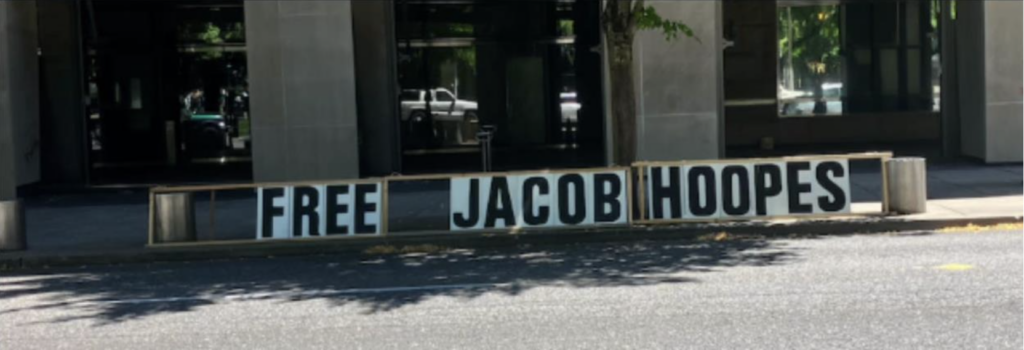
Sign reading “FREE JACOB HOOPES” displayed outside of the federal courthouse located in downtown Portland, Oregon. (July 28, 2025)
On July 25, 2025, 24-year-old Reed College graduate, Jacob Hoopes, was violently arrested by the FBI during a raid of his home in Portland, Oregon. Hoopes appeared in federal court on July 28, 2025 on felony charges of aggravated assault on a federal officer with a dangerous weapon, and depredation of federal property exceeding $1,000. The FBI’s criminal complaint against him was unsealed shortly after his initial court appearance.
Here’s what we know — and what you should know, too.
Hoopes’ criminal complaint was originally filed in federal court on July 24, 2025, at 4:00 p.m. — just 17 hours before the raid occurred on his home the following morning.
In the complaint, an unnamed FBI Special Agent alleges that on June 14, 2025, Hoopes was present at the ICE facility on SW Macadam Avenue in Portland, OR. On that day, a large crowd broke away from the end of a “No Kings Day” rally near the waterfront and made their way to the ICE facility, where a riot was later declared that evening.
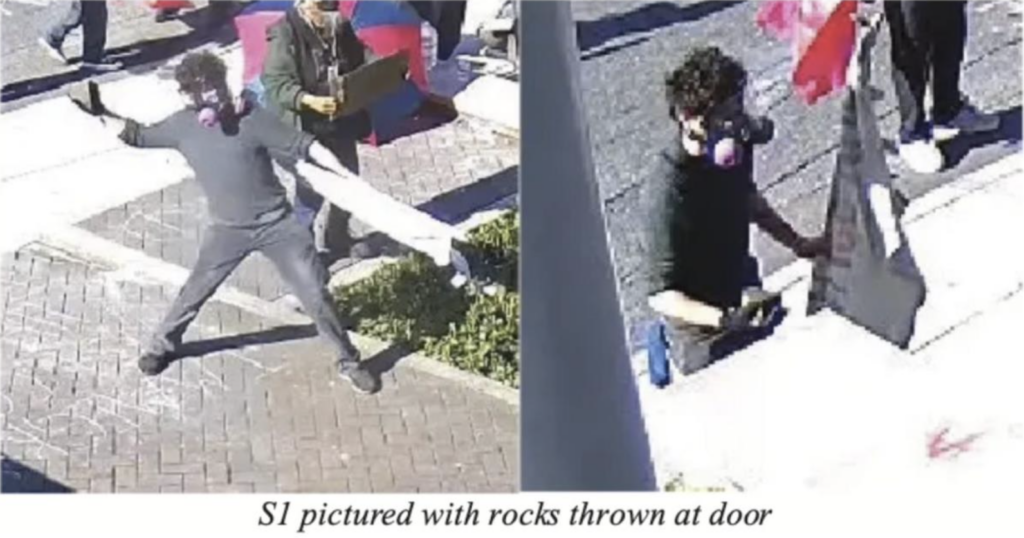
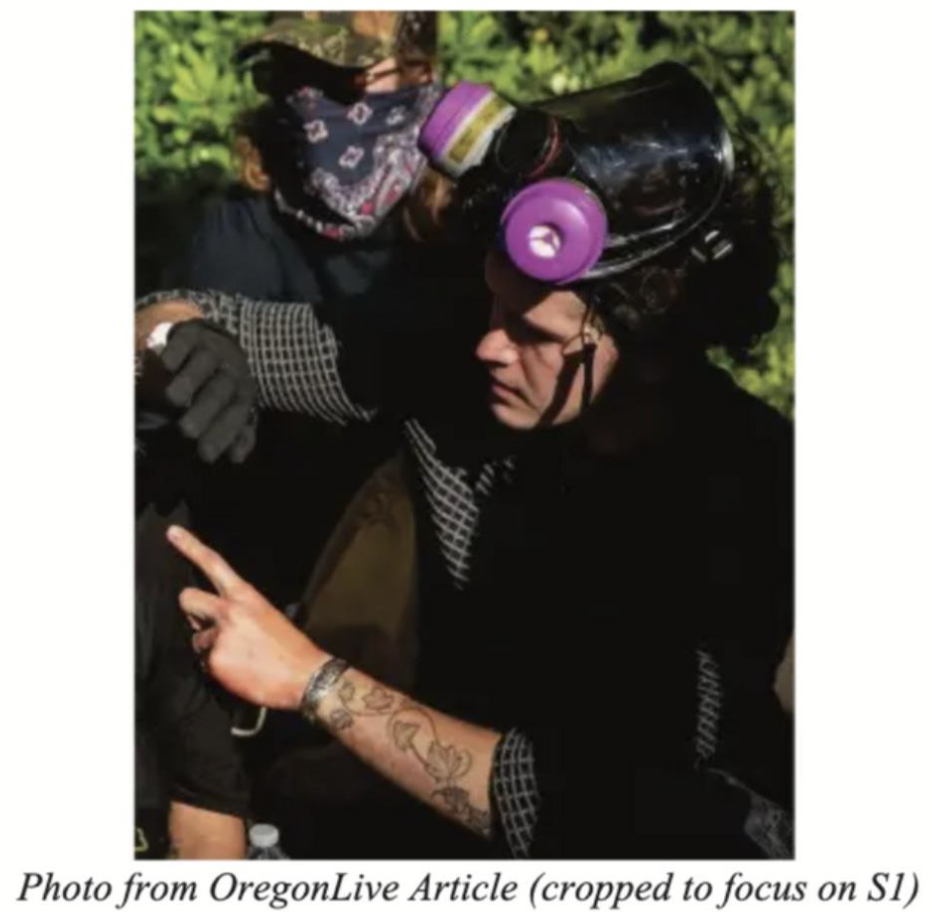
The Special Agent included surveillance footage showing a masked protester, identified as “S1” (Subject 1), who appears to be throwing large rocks toward the front of the building.
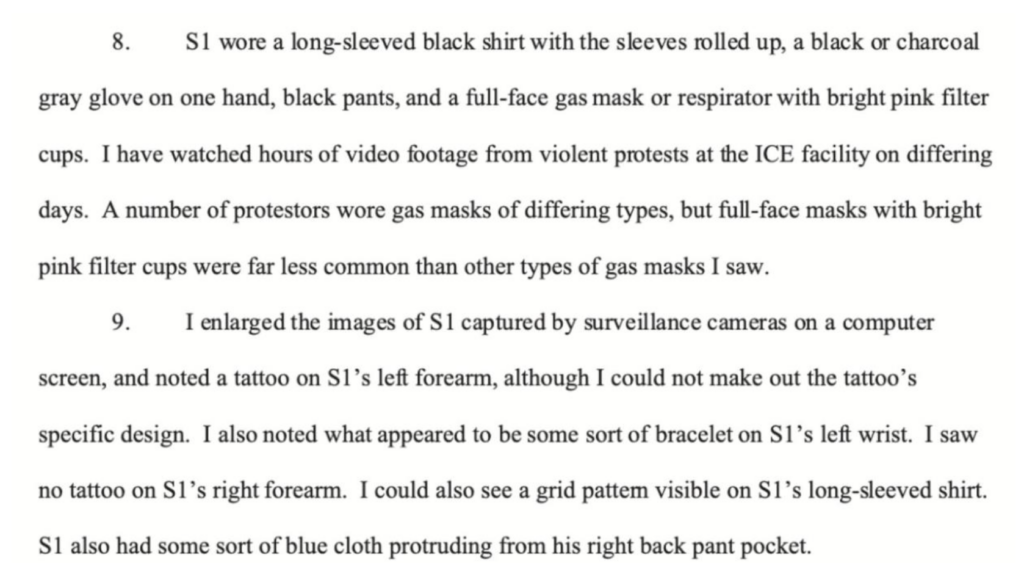
The unnamed Special Agent identifies “S1” based on the clothing and gas mask they wore, as well as a visible tattoo on the suspect’s left forearm and a distinctive silver bracelet on their left wrist. It is important to note that as part of their investigation, the unnamed Special Agent also mentions watching “hours of video footage from violent protests at the ICE facility on differing days”.
An excerpt from the federal affidavit.
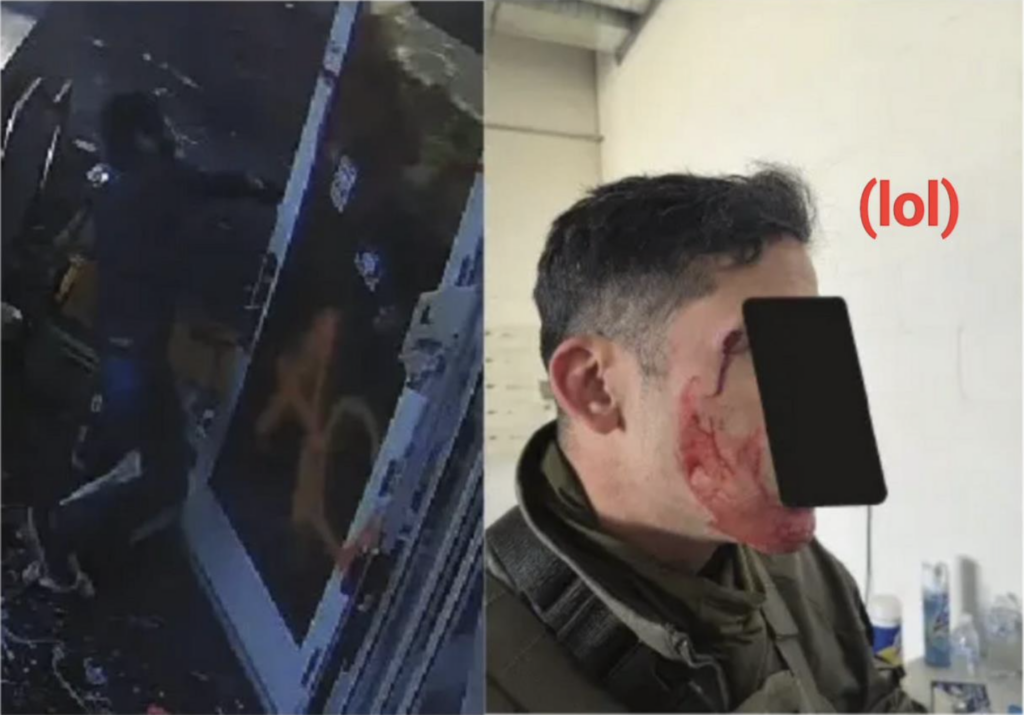
The unnamed Special Agent then alleges that during an attempt by federal agents to clear obstructions placed in the building’s doorway, “Subject 1” threw a rock that struck a federal officer in the face, causing significant injury. The officer is identified in the affidavit as “AV1” (Adult Victim 1).
Excerpt from the federal affidavit.
“AV1” was reportedly hit while wearing his gas mask and allegedly “bled profusely” from a wound above his right eyebrow. He states that he received first aid from other officers on site, which was unsuccessful, and later required further medical attention.
During the alleged assault, “AV1” claims he was able to clearly see “Subject 1” and identified him as “a male wearing a dark-colored long-sleeve shirt with the sleeves rolled up, black pants, and a full-face respirator with pink filter covers.” Shortly after the alleged assault, the criminal complaint states that “Subject 1” was seen with two “as-yet unidentified people” using the metal pole of a stop sign as a “makeshift battering ram,” striking the front door of the facility multiple times.
The affidavit alleges that “Subject 1” was “leading the charge” and caused structural damage to the door, with the estimated cost to replace it totaling $7,747.72. At this point, the criminal complaint provides a more detailed description of the tattoos on “Subject 1’s” left arm, described as “leaves.”
Later in the complaint, it states that on June 20th, just six days after the alleged incident, “AV1” provided the unnamed Special Agent with a news article posted on OregonLive.com. The article was posted at 6:48 p.m. on June 14th, just shortly after the events alleged in the criminal complaint. The article includes a photo of a protester whom the Special Agent alleges is “Subject 1.” The image shows a protester without a face covering providing aid to another protester who appears to be injured.
The criminal complaint further states that the specific photo from the OregonLive article was run through a commercially available facial recognition software during a demonstration for the United States Attorney’s Office. This software generated 30 possible comparison photos sourced from various public databases. The FBI field office in Portland reviewed all of these photos and identified one from a Reed College photo-sharing page. The complaint alleges that this image from the website shows a person similar in build to “Subject 1,”with a tattoo on the left forearm that matches the one visible in the OregonLive photo. It also notes that neither image shows tattoos on the right arm.
The software also returned an Instagram account under the name “Jacob Hoopes,” with a bio reading “Reed CS 2023.” The profile was private, and no additional content was accessed, aside from a visible profile photo showing an individual with long hair wearing a shirt with “REED” printed on the front.
The unnamed Special Agent then contacted the Director of Community Safety at Reed College, who provided alumni information about Hoopes to federal authorities. Notably, this information was shared without a warrant or subpoena, and Reed College has since terminated the Director, alleging that these actions specifically violated the school’s policies of protecting private studentinformation.
The Special Agent then went on to use publicly available information from the Reed College website, which confirmed that Hoopes graduated in 2023 with a degree in computer science. The unnamed Special Agent then requested and accessed records from the Oregon Department of Motor Vehicles, where he found a driver’s license issued to an individual with the same name and address as the person listed in the Reed College alumni records.
According to the complaint, the Special Agent later conducted a spot check of the address listed in both the alumni and DMV records. Using binoculars, he observed an individual on the front porch of the residence who appeared to have the same leaf tattoo and silver bracelet on their left arm as “Subject 1.”
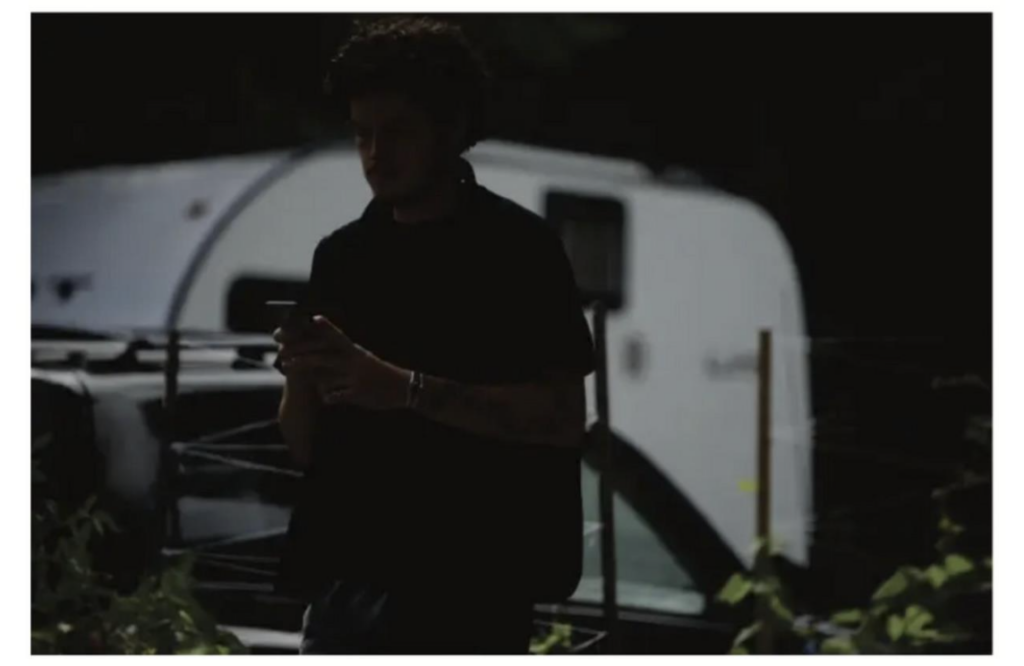
The FBI later conducted surveillance of Hoopes’ home on July 10, 2025 – 26 days after the events alleged to have occurred on June 14 and 15 days before the raid on his home. During this surveillance, agents captured a photo of Hoopes.
According to the criminal complaint, the photo shows the same forearm tattoo and silver bracelet seen on the individual identified as “Subject 1.” Once again, the complaint notes that there are no visible tattoos on the person’s right arm.
Image provided from the federal affidavit.
The affidavit concludes with a request for the court to seal all records submitted in support of the criminal complaint and arrest warrant. The unnamed Special Agent argues that sealing is necessary because the investigation remains ongoing, Hoopes had not yet been contacted by law enforcement, and he was likely unaware that he was under investigation. The agent further claims that disclosing any information could endanger individuals’ safety, lead to evidence tampering, intimidate potential witnesses, or seriously compromise the integrity of the investigation.
A United States Magistrate Judge signed the arrest warrant, and Hoopes’ home was raided at 9:00 a.m. the following morning.
All of this information raises serious concerns.
Hoopes is now the second person in Portland to be taken from their home by the FBI since June, in connection with alleged activity at the ICE facility on SW Macadam Avenue. Another individual was initially arrested by Portland Police at the scene of the June 14th protest and was later picked up on federal charges. However, Hoopes is the first to have no prior criminal record, no arrest, and to have his home also subsequently raided by federal agents.
While increased FBI activity in our community is troubling, there are also important takeaways here for those involved in resisting ICE operations here in Portland, as well as those engaged in broader liberation struggles.
It is increasingly clear that federal authorities are engaging in long-term, retrospective surveillance and prosecution of protesters, even weeks or months after the events in question. Hoopes’ case is just one example out of many. His federal complaint wasn’t filed until July 24, a full six weeks after the alleged protest activity at the ICE facility took place. This delay suggests that the FBI is quietly collecting intelligence, cross-referencing media, and compiling identities well after the fact, and largely outside public view. It is apparent that their investigations are relying almost entirely on open-source intelligence, including surveillance footage, media coverage, and private social media accounts.
Clearly, going home right after a protest without being arrested does not guarantee safety from later prosecution and capture.
When attending an action, it’s critical to obscure any identifiable features, for your safety and for the safety of those around you. Avoid exposing tattoos, faces, or other distinguishing marks while on the ground. Wear nondescript clothing that helps you blend in with the crowd. If you share protest photos publicly, always block out faces, tattoos, logos, or unique clothing items.
Better yet, reconsider taking photos at all.
Even well-intentioned posts can end up in a federal affidavit. So can your Instagram profile picture. Journalists aren’t always on our side, and neither is their reporting.
The fact that Hoopes’ arrest was based in part on an AI detected college event photo, a private Instagram profile, and binocular surveillance from a public street raises serious concerns. It showcases just how expansive and often indiscriminate federal scrutiny has become. The FBI is clearly willing to scrape through every available corner of a person’s life to build a criminal case, even when the evidence is largely circumstantial at best.
It doesn’t matter how “peaceful” you are or what kind of reputation you hold in your community, if you stand in their way, the Feds will paint you out as a dangerous threat.
This is why it’s essential to be prepared before anything happens. Know your legal rights. Memorize a legal hotline number. Set up a jail support plan and share an emergency contact list with trusted people. Assess how to prepare your home for a potential raid.
What Hoopes’ case illustrates is that state repression is methodical, and it is aimed at dismantling movements by isolating individuals and instilling fear. The best way to resist this is collectively, by organizing for legal defense, educating our communities about digital and physical security, and refusing to let these tactics deter our struggle for justice.
Hoopes isn’t deemed “peaceful” by the state, but that does not mean that he is any less deserving of support and solidarity. We know that the masses are not the ones that get to decide what is and is not peaceful, the state does. And when we legitimize this rhetoric of theirs that only “peaceful” protestors deserve our support, the state just continues to label more of us as “un-peaceful”. It is a way of manufacturing consent for our abductions.
We reject this rhetoric that we ought to alienate ourselves over how we rebel against our oppressors. Solidarity with Jacob and all those engaged in the revolt against ICE, innocent or not.
Today in federal court, 47-year-old trans woman, Julie Winters, was sentenced to three years of supervised release after pleading guilty to felony intimidation of a federal officer.
Julie Winters was initially arrested at the ICE facility in Portland, Oregon this previous June, after protests took off at the height of the summer against the federal agency. At the time of her arrest, Julie lived across the street from the ICE facility in a low-income apartment that she hoped would get to be her “forever home”, before it became the epicenter of brutal assaults and aggression at the hands of federal agents against people in the city. For months, Julie’s neighborhood was bombarded by flash bangs, tear gas, pepper bullets, and other crowd control ammunitions used relentlessly for hours into each night. Notably, the elementary school to the east of the ICE facility and directly across the street from Julie’s apartment was forced to relocate after the feds poisoned the playground for months with tear gas and other explosives.
In late June, Julie was arrested at the facility after she allegedly attempted to place a bike lock on the building’s gate, in an effort to delay federal aggression against the protestors that night which resulted in multiple people being hospitalized. Federal agents allege that Julie menaced them with a knife and that she possessed an incendiary device, which was never recovered. Charges relating to possession of an incendiary device that night were ultimately dismissed by prosecutors after reviewing video footage directly refuting those specific allegations.
The night of her arrest, Julie was carrying a kitchen knife on her for the sake of self defense, as she is a victim of stalking and the police department has assured her there is nothing they can do about it. Julie tossed the knife into a bush when she realized federal agents were pursuing her after she attempted to chain up the gate, but she was still ultimately charged with felony intimidation of a federal officer. The feds referred to the officers who brutalized her that night as “her victims”. Julie left the facility after her violent arrest in an ambulance.RSJulie was initially out on pre-trial release before being violently re-arrested by US Marshalls during a routine check-in with pre-trial services. She was then put into a solitary confinement cell for six weeks before ultimately being let out on house arrest later in the summer. As of this morning, Julie is no longer required to wear the court issued GPS tracking device that has been on her ankle since the beginning of her home confinement.
From the start, Julie’s prosecution has been utterly political, and multiple police departments have collaborated with one another to brutalize and repress her. In December of 2024, Julie was violently beaten to the point of death by Portland Police officers Max Freund and Henry Vasend — who beat her so viciously that she had to be revived at the hospital. Julie was ultimately the one charged for the incident and was forced to navigate court in Multnomah County for the better half of nine months without being appointed a public defender. Despite the fact that Julie’s violent assault was a well documented incident that circulated across social media, PPB Chief Bob Day denied any knowledge of wrongdoing by his officers after being confronted about it in public by members of the community. Either violent assaults against trans women are so common that Bob Day just can’t keep track of them anymore, or he is just utterly uninterested in addressing the corruption of his officers and cares exclusively about the public image of the bureau. It’s probably a combination of both.
At her sentencing hearing, Julie was appointed 13 points on the court’s sentencing table. The federal sentencing guidelines use a point based system to determine sentences based on two main factors: the offense level of the crime and the criminal history of the defendant. Each offense is assigned a level from 1 to 43 and prior convictions are scored to categorize the defendant. It is the mix of both of these factors on the sentencing table that provides the judge with a recommended range of imprisonment. Julie was given a range of 12-28 months, with the judge ultimately sentencing her to time served with 3 years of supervised release.
The most notable portion of the sentencing hearing was the specific contentions raised regarding the updated Presentence Report (PSR) that was submitted to the court just a few days before Julie’s sentencing hearing and contained new proposed conditions of her release. A PSR is prepared by the U.S. Probation Officer and provides detailed information about a defendant’s specific background and circumstances, and it is used as an important reference document by the judge before imposing the final sentence for a defendant.
In the amended PSR, the government moved to request even more repressive conditions on an already lengthy list of supervision restrictions. The government argued that Julie should not be allowed to post anything relating to immigration and law enforcement online, and that she must surrender any devices she uses for the government to install tracking software onto them. They also made note that Julie should be barred from using any and all forms of encrypted messaging, and that those she has regular contact with should be made aware that their devices may also be subject to search if there is reason to believe Julie accessed them in any way.
Julie’s attorney rightfully argued that these restrictions were a direct violation of his client’s constitutional rights, and a judge ultimately dismissed them altogether, after a poor articulation from the prosecutor on why they were justified conditions. The government argued that Julie was not being targeted for her political values, and that they did not believe she was a “radical anarchist out to overthrow the government.” They argued that Julie was clearly just a very mentally ill individual and needed to be prevented from accessing radicalizing media that was making her have the grand delusions that there needed to be a revolution. Had the state thought Julie was indeed “an anarchist,” the prosecutor argued that they would have “sought out the max.”
Julie spoke out in court to contest this false characterization of her politics as being symptoms of episodes of psychosis or due to her failing mental health, arguing that anyone would be traumatized after experiencing the violence that she has at the hands of the police, but her mental health is not what made her believe that she needed to speak out against the actions the government was taking that she did not morally agree with. The state’s attempts to cast her as “mentally ill” directly showcased the ways in which it weaponizes mental health as a means to pacify political dissent in those who express it boldly. To them, being a radical is seen as a mental health deficiency, and in their opinion, it is only able to be remedied with the poisonous medicine of the criminal justice system.
While the court shot down the additional restrictions that the government attempted to impose, it is important to note that Julie has already been repressed heavily throughout the entire process leading up to sentencing. Months prior, the magistrate judge ruled on the case that Julie could not discuss the details of her case with others, and she was not allowed to post anything online regarding law enforcement or ICE. This gag order was handed down after the state initially argued that Julie should be allowed to have no social media whatsoever, claiming that social media was used to radicalize militants against the government.
Although the court did not impose the supplemental restrictions suggested for Julie in the amended PSR at her sentencing hearing, the court did meet some of the direct requests made by probation officers — specifically requesting that Julie be forced to attend meetings with the office with no support from her community, and that Julie is not to film any matters relating to visits from the Office of Probation and Pre-Trial Services. The court ruled that if Julie had friends or family over in her apartment during a surprise visit, she is required to make them leave and to complete the duration of the visit entirely by herself. This restriction was placed out of the interest of “officer safety,” without the consideration of what this means for a victim of violent police brutality, who has already been viciously beaten in previous check-ins with her pre-trial officer. Why is the court so afraid of someone being witness to Julie’s interaction with federal officers?
On totally random and completely unrelated note, a criminal defense attorney had his briefcase seized by the feds after leaving the federal courthouse a few days ago. That attorney is one of Julie Winters’ lawyers on this case.
Julie has been without employment for months, and although she is back at home and finally off of house arrest, the next three years are still long ahead of her. Julie needs support from her community as she navigates being under federal supervision for the next 36 months, with the risk of re-arrest looming over her in the event of any violations of her probation. Since her arrest, Julie has been relentlessly doxxed by fascists such as Andy Ngo, who have labeled her “trantifa,” and she has been displaced from her home.